
Holy Week 2027: Antigua Guatemala
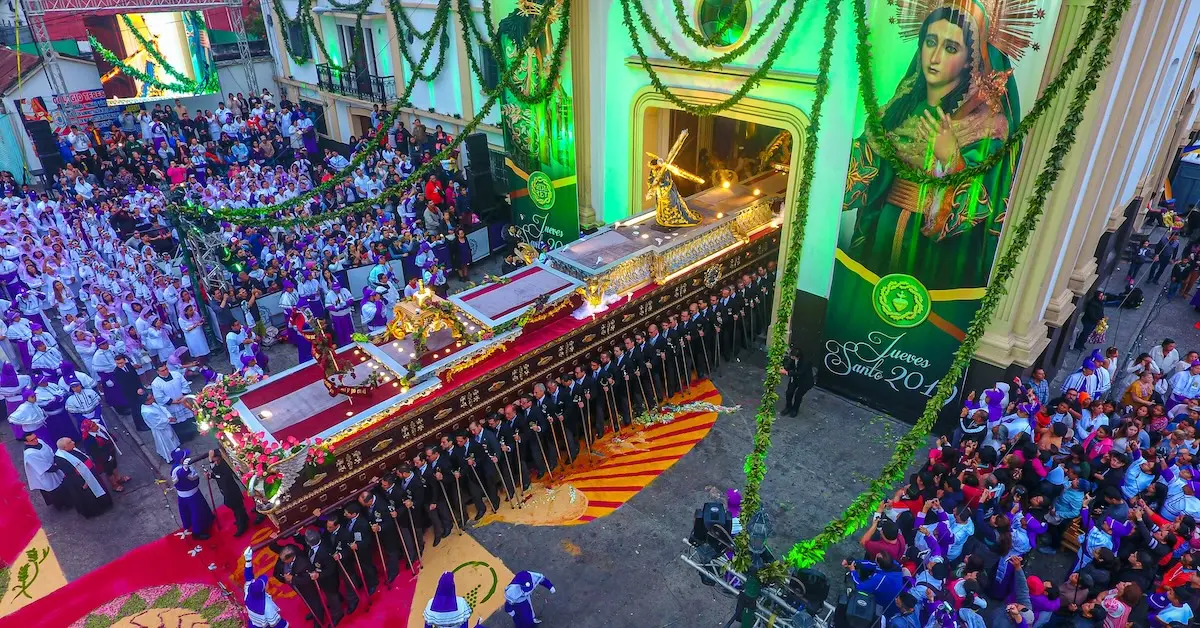
Locals in purple robes carry processions through the cobblestone streets alongside live bands playing funeral marches. The marchers walk over the street carpets, crushing the dyed sawdust and fresh flowers. The week peaks on Good Friday with the largest processions from La Merced Church and San Felipe de Jesus.

Holy Week in Antigua Guatemala is not to be missed. The entire city revolves around the festival for the full week and you’ll be immersed in the colors and vibrant celebrations of this special time. It’s a unique experience that is highly anticipated by both tourists and locals.
Throughout the week, numerous processions parade through the streets, stunning carpets made of sawdust, flowers, fruits, and food that is hard to find at any other time. Holy Week or Semana Santa is Antigua’s time to shine. We’ll make sure you don’t miss any of the top sights while you visit the city during the festivities.
Holy Week in Antigua
UNESCO’s Cultural Heritage
Holy Week in Antigua
An emotional experience
Processions
The heart of the celebrations
Carpets
The pathways of the processions
Holy Week in Antigua Guatemala: Trip Highlights
Whether you’re religious or not, you’ll appreciate the devout faith that goes into the Holy Week celebrations in Antigua Guatemala. Every sense will be engaged, from the rich scent of incense and the pine needle carpets, the delicious sweet treats sold at local stands, and the solemn funeral marches played by bands that follow each float.
You’ll have a chance to really experience the unique culture that surrounds this time of year. While North Americans hunt for eggs and eat chocolate, Guatemalans pay their respects to an older tradition.
Simple materials like sawdust, flowers, and even fruits and vegetables are used in stunning carpets. The entire city comes alive for the week, with an influx of thousands of visitors, eager to see the carpets and processions.
Antigua’s Holy Week traditions transform the city into an immersive sensory experience. You will walk alongside miles of intricate alfombras (street carpets) built by hand from dyed sawdust and pine needles, while the solemn rhythm of traditional funeral marches echoes off the colonial facades. It is a display of devotion, anchored by wooden processions carried through the historic avenues by hundreds of dedicated locals.
Purple-robed “cucuruchos” or faithful worshipers carry the massive floats, switching up every block. You’ll see columns of these men walking along the parade route, helping keep the crowds back and the procession path clear.
As the procession moves along the street, hundreds of feet destroy the temporary carpets, so it’s a good idea to snap a photo while you can. You’ll have a chance to watch as families and neighbors gather late at night and early in the morning to create the carpets and we’ll walk the streets so you can get some good shots of the finished designs.
Day 1: Holy Wednesday, March 24, 2027
Upon your arrival at Guatemala City’s international airport, we’ll have someone meet you and take you directly to Antigua. There are three main events today that you can attend. Please keep in mind that we provide the start times for the most important events, but each one may last for several hours. Some processions go on for up to 20 hours!
Upon arrival in Antigua, you’ll visit the Vigil in Escuela de Cristo, where you can observe the intricate carpet created there. After lunch, we’ll walk to a good location to see the children’s procession that emerges from La Merced, a beautiful yellow church that is central to many of the Holy Week events.
There is another procession that begins at 3pm, which leaves San Felipe de Jesus and winds through Antigua. We’ll catch it when it passes through a central point in Antigua. You’ll spend your evening wandering the cobblestone streets, watching as families work together to create amazing works of art in the streets.
The extent of today’s activities depends entirely on your flight arrival time into Guatemala. Review the program below, which you and your guide will tailor together as soon as you meet to ensure a seamless start to your trip.
Holy Wednesday Program: March 24, 2027
Holy Week in Antigua operates on a 24-hour schedule of devotion, so trying to see everything will only leave you exhausted. Instead, you can plan directly with your expert guide to select the specific vigils and processions that interest you most. To ensure you experience these moments comfortably, your guide will also secure access to private colonial balconies and strategic viewing locations away from the heaviest crowds.
08:00 AM – 11:00 PM | Vigil of Señor Sepultado at Escuela de Cristo
This specific vigil is known for its quiet, serious atmosphere. Inside the dark stone church, the wooden seating is entirely removed to make space for a massive sawdust carpet on the floor. At the end of this artwork rests the altar of the Señor Sepultado (the Buried Christ). Locals gather closely to pray while burning copal (a traditional incense made from tree resin).
08:00 AM – Midnight | Vigil inside Templo de La Merced
In contrast to the quiet Escuela de Cristo, the vigil inside this bright yellow church is much larger and more elaborate. The thick, earthquake-proof walls create a massive space where the community builds towering altar displays called huertos (temporary indoor gardens). As you walk through the church, you will see the main historic statue of Jesus surrounded by intricate offerings of fresh local fruit, vegetables, and baked bread.
08:00 AM – 02:00 PM | Carpet Preparation in San Felipe & Northern Antigua
At the northern edge of the city, you can watch how the street art begins. Entire families take over the cobblestone roads to lay down a thick base of fresh pine needles. This green layer creates a strong scent in the air and serves as the foundation for the famous alfombras (colorful sawdust carpets).
12:00 PM – 05:00 PM | Carpet Making on the Central Streets
Closer to the city center near Calle del Arco, the streets turn into an intense outdoor workshop. To avoid ruining the edges of their work, artists kneel on wooden planks suspended just above the ground. From there, they use cardboard stencils to carefully pour brightly colored sawdust into large geometric patterns.
01:00 PM – 01:45 PM | Carpets in San Felipe
Right before the afternoon processions begin, there is a short window to walk through the San Felipe neighborhood. This is the absolute best time and location for photography because the carpets are completely finished and untouched, sitting perfectly still just before thousands of heavy footsteps sweep over and destroy the designs.
Day 2: Maundy Thursday, March 25, 2027
This morning, you’ll start off with a tour of the colonial city of Antigua Guatemala. This was the third capital of Guatemala until a disastrous earthquake caused people to abandon it and move to Guatemala City. Today, Antigua is a UNESCO World Heritage site and is a popular destination among travelers. Thanks to its old-fashioned feel, you can see what life must have been like back in the day.
Once you’ve visited several impressive churches and ruins that are scattered throughout the city, it’s time to check out the processions for today. There are two, one of which will leave from San Cristobal El Bajo around 11 am and another leaving from Antigua’s San Francisco church around 1 pm. As before, we’ll see a portion of these processions as they pass a more accessible part of Antigua and you can truly appreciate the beauty of the floats that take a full year to design and decorate.
Maundy Thursday Program: March 25, 2027
Maundy Thursday shifts the focus toward massive morning processions and exploring the city’s historic ruins. Because the schedule runs deep into the night again, you will continue working closely with your guide to pick the exact events you want to see. You can comfortably skip the late-night returns if you prefer to rest before Good Friday.
04:00 AM | The Early Return at Santuario de San Felipe
If you are awake before dawn, you can watch the Wednesday procession finally end. The carriers must carefully angle the massive wooden float to fit it back through the sanctuary doors, marking the physical end of a march that lasted nearly 15 hours.
05:00 AM – 09:00 AM | Early Morning Flower Carpets in San Cristóbal El Bajo
Unlike the sawdust carpets in the city center, the street art in this neighborhood is made almost entirely of fresh flowers and corozo (a native palm). The locals work quickly in the early morning cold to arrange the petals and leaves, creating a completely different, natural scent along the route.
06:00 AM – 12:00 PM | Morning Vigils and Monumentos
Thursday morning introduces a specific tradition where major churches display Monumentos (special altars celebrating the Holy Communion, or the bread and wine). When you walk inside, the setup is distinct from Wednesday’s vigils: these altars are decorated almost entirely with hundreds of white lilies and lit by massive banks of candles.
07:00 AM – 11:00 AM | Carpet Preparation near San Francisco El Grande
While the early morning routes use fresh flowers, the streets surrounding the massive San Francisco church rely on the classic dyed sawdust and pine needles. You can walk the wide avenues leading away from the church to watch locals build these large-scale designs in preparation for the afternoon crowds.
07:00 AM | The Start of Jesús Nazareno de la Humildad
Instead of a quiet exit, this morning procession from the Templo de San Cristóbal El Bajo begins with the loud sound of live trumpets. You can watch the carriers carefully maneuver the heavy wooden float through the front doors of the church to officially launch their route.
08:00 AM – 09:00 AM | Fresh Carpets in San Cristóbal El Bajo
Walking just a few blocks ahead of the approaching floats is the best way to experience these specific carpets. Because the neighbors here use fresh flower petals and corozo palm leaves instead of sawdust, you can clearly smell the natural materials right before the procession walks over them.
09:00 AM | Departure of Jesús Nazareno del Perdón:
At 9:00 AM, the Jesús Nazareno del Perdón float leaves San Francisco El Grande. If you want to see exactly how much physical strength these processions demand, this is the departure to catch. Hundreds of cucuruchos (purple-robed carriers) must lift this massive mahogany float in perfect unison, stepping slowly to the heavy rhythm of a traditional marching band. The immense weight of the wooden structure—which can reach several tons—and the intense coordination required just to clear the plaza make this one of the most impressive physical feats of the morning.
09:30 AM – 11:30 AM | Antigua Cathedral Ruins and Local Food:
Once the float passes, your expert guide will lead you away from the dense crowds and over to the Antigua Guatemala Cathedral. Behind the restored front church, you will pass through a low brick archway straight into the roofless 18th-century ruins. Your guide will walk you through the ten-foot-thick stone pillars and collapsed vaulted ceilings that remain exactly where they fell during the 1773 earthquake.
Down in the dark subterranean crypts, modern Maya spiritual guides still burn candles on soot-stained altars, actively practicing a blend of Catholic and indigenous traditions. When you head back out to the street, your guide will stop at a local vendor so you can try fresh dobladas (crispy, folded tortillas filled with meat and potatoes) right off a hot comal (flat griddle).
10:30 AM – 01:00 PM | The Carpets of Templo de San Francisco El Grande:
By mid-morning is the best time to walk the blocks surrounding the historic Templo de San Francisco El Grande. Here, the neighborhood alfombras (street carpets) stand out for their complex artistry, featuring elaborate biblical portraits and vibrant geometric patterns. Because these pieces sit on the final return route of the heavy afternoon floats, local families construct them using thick bases of dyed aserrín (sawdust) and crushed pine needles, balancing delicate visual details with a dense foundation that holds its shape over the cobblestones.
10:30 AM | Jesús Nazareno de la Humildad at Templo de la Escuela de Cristo:
Just down the street at the Templo de la Escuela de Cristo, you can catch the Jesús Nazareno de la Humildad procession. This 17th-century parish retains its original unpainted volcanic stone, offering a dark, plain background that sharply contrasts with the passing wooden float and the bright purple robes of the carriers.
01:30 PM | Jesús Nazareno de la Humildad at Cementerio de San Lázaro:
By early afternoon, the procession reaches the city limits at the Cementerio de San Lázaro. The wide avenue in front of the white mausoleums provides a clear, uncrowded view of the exhausted cucuruchos (purple-robed carriers) shifting the heavy wooden structure. Out in this open space, away from the tight acoustics of the city center, you can clearly hear the dragging of their boots and the heavy beat of the traditional funeral marches.
04:45 PM | Jesús Nazareno del Perdón at Central Park:
Late in the afternoon, the Jesús Nazareno del Perdón procession reaches the dense crowds at Central Park. Turning the heavy wooden structure around the Fuente de las Sirenas (Sirens’ Fountain) in the middle of the plaza is one of the tightest and most physically demanding sections of the route. After more than seven hours on the street, the exhaustion of the cucuruchos (purple-robed carriers) is fully visible. You can see them struggling to push through the crowds while forcing themselves to keep stepping to the slow beat of the marching band.
06:00 PM – Midnight | Good Friday Carpet Preparation:
As evening falls, the city begins its overnight preparations for Good Friday. If you walk the central avenues under lamplight, you can watch local families building the largest alfombras (street carpets) of the week. Because these designs cover entire city blocks and must be finished by dawn, neighbors work together through the night. You will see them packing down thick bases of dyed aserrín (sawdust) and arranging fresh pine needles over the cobblestones to create miles of uninterrupted street art.
11:30 PM | The Return to San Francisco El Grande:
The day concludes back at the Templo de San Francisco El Grande for the final return of the Perdón procession. After more than fourteen hours on the street, the carriers face one last physical challenge: they must carry the massive mahogany structure completely backward into the church. They do this intentionally so the image of Christ remains facing the plaza and the gathered crowd right up until the heavy wooden doors close.
With the city bracing for the intense dawn of Good Friday, this evening offers a perfect opportunity to step away from the crowds. Take some free time to relax with a cup of authentic Guatemalan coffee in a restored colonial courtyard, walk through the artisan markets, or enjoy a quiet dinner at one of the city’s finest restaurants before resting up for tomorrow.
Day 3: Good Friday, March 26, 2027
It’s Good Friday and this is the most important day of Holy Week in Guatemala. The events center around La Merced, the golden yellow church to the north of town. Around midnight, a centurion rides a horse out of the church, pausing to read out the sentence against Jesus at several stops. Between 3-4 am, Roman soldiers ride out on horseback or walk through the streets to “search” for Jesus. The main procession starts around 4 am. This is the most impressive procession of the week, but it also runs for most of the day, so you’ll have a chance to enjoy it a little later.
In the morning, the men carrying the Jesus float wear purple robes, but after the crucifixion ceremony (there are two, one at the main Cathedral in the park and another at the Escuela de Cristo) around noon, the robes change to black for mourning. You’ll see three more processions throughout the day, including the biggest one that comes from Escuela de Cristo, to the south of the city. As it passes Central Park, there is a huge ceremony that you won’t want to miss out on.
Good Friday is also the best day for seeing carpets, so we’ll do some walking today. You’ll be amazed at how much work goes into creating every last detail in these masterpieces.
Good Friday Program: March 26, 2027
Good Friday is the most spectacular day of Holy Week, known for the massive scale of its street art and a dramatic visual transformation that happens halfway through the day. The schedule runs continuously from midnight all the way through the following morning. Even though the city is full of visitors for the main events, the streets are closed to car traffic, creating a wide pedestrian zone with plenty of room to comfortably walk and admire the carpets. You will plan directly with your guide to select your preferred processions and secure private balconies for the best elevated views.
12:00 AM (Midnight) – 04:00 AM | Overnight Carpet Preparation
Instead of sleeping, hundreds of locals spend the cold early morning hours working in the streets. You can walk the main routes to watch families carefully pouring the final layers of dyed sawdust to complete the largest continuous carpets of the entire week.
02:00 AM – 04:00 AM | The Best Time for the City Center Carpets
If you are willing to be out in the middle of the night, this is a unique window for photography. Walking the central streets at 2:00 AM allows you to see the most impressive sawdust carpets completely finished in perfect quiet, hours before the morning procession arrives to walk over them.
02:50 AM | The Start of Jesús Nazareno from La Merced
This specific procession starts hours before the sun comes up. As the heavy wooden doors of the La Merced church open, the massive float of Jesús Nazareno (Jesus of Nazareth) is carried directly into the dark streets. The carriers, known locally as cucuruchos, wear bright purple robes, establishing the distinct visual tone for the first half of Good Friday.
06:00 AM | The Roman Guards at Central Park
As the sun rises over the main plaza, a unique tradition takes place. Men dressed as Roman soldiers ride through the streets on horseback to publicly read the Sentencia (the formal condemnation of Jesus). This specific moment adds a vivid, living element to the morning that you do not see on other days of Holy Week.
08:00 AM – 02:00 PM | Building the Dark Afternoon Carpets
While the early morning street art features bright, vibrant colors, the mid-morning carpet preparations show a deliberate shift in the city’s mood. Families begin building entirely new alfombras (carpets) specifically for the afternoon routes, replacing the bright dyes with dark-toned sawdust, black ashes, and deep purple flowers to match the serious tone of the later events.
12:00 PM – 03:00 PM | Crucifixion Services and the Glass Urns
Inside major churches like La Merced and Escuela de Cristo, a highly specific ceremony takes place. Locals gather to watch as the wooden statues of Jesus are physically taken down from their crosses and carefully placed inside glass urns (traditional glass caskets). This physical action prepares the figures for the afternoon’s Santo Entierro (Holy Burial) processions.
01:00 PM – 03:00 PM | Walking the Afternoon Carpet Routes
Before the afternoon processions begin, you have a short window to walk the streets and see the freshly built, dark-toned carpets. Unlike the bright designs from the morning, these carpets use black sawdust and dark purple flowers that stand out clearly against the cobblestone streets.
02:00 PM | The Return to La Merced
As the morning procession finishes and the float returns to the La Merced church, a massive visual change happens right in the streets. Thousands of carriers take off their bright purple robes and immediately change into black tunics. From this exact moment through the rest of the weekend, the entire color palette of the crowds shifts completely to black.
03:00 PM | The Start of the Santo Entierro from San Felipe
The afternoon shifts completely to the traditions of the Santo Entierro (Holy Burial). You can stand near the San Felipe church to watch the massive anda (wooden processional platform) carrying the Señor Sepultado (the Buried Christ) exit the building. Instead of the trumpets heard during the morning events, this specific procession moves to the slow, steady rhythm of a single drum.
03:30 PM | The Escuela de Cristo Procession
Just a half-hour later, a second major burial procession starts from the southern edge of the city. Because the streets are filled with the scent of burning copal (traditional incense) and the carriers are dressed entirely in black, the atmosphere here is noticeably quieter and more serious than the earlier daytime events.
04:30 PM | The San Felipe Procession Reaches Jocotenango
As the afternoon continues, the San Felipe procession crosses into the neighboring area of Jocotenango. Walking alongside the route here is a great time to see the immense physical effort of the carriers, who must carefully balance the heavy wooden platform over the uneven cobblestones and freshly made carpets.
06:30 PM | The San Felipe Procession at San Sebastián
As the sun sets, the San Felipe procession passes the ruined columns of the San Sebastián plaza. The shift into the evening completely changes the visual experience. The massive anda (wooden platform) is now illuminated by its own built-in lights, which cast long shadows and make the details of the platform stand out sharply against the dark stone ruins.
09:00 PM | The Escuela de Cristo Procession at the Cathedral
While the San Felipe route is still making its way through the northern neighborhoods, the Escuela de Cristo procession reaches Central Park. The anda stops directly in front of the San José Cathedral. The musicians playing the slow funeral march pause as the local priest steps out to receive the procession, and a choir or a single singer performs a traditional religious song. This is one of the only moments during the entire week where the instruments are completely replaced by live singing.
10:45 PM | The San Felipe Procession at Central Park
Nearly two hours later, the San Felipe procession finally reaches the same main plaza. Unlike the vocal performance at the Cathedral earlier in the evening, the atmosphere here relies entirely on the heavy, slow drumbeat and the glow of handheld candles carried by the followers. Watching this second dark platform move slowly across the central square in the candlelight serves as a quiet, iconic close to the main events of the day.
12:15 AM – 07:15 AM (Saturday) | The Late-Night Returns (Optional)
For the rest of the night, both the San Felipe and Escuela de Cristo processions continue their long routes, passing landmarks like the yellow Santa Catalina Arch before finally returning to their home churches at dawn. Because the Friday schedule is so long, you are completely free to skip these late-night hours. Instead, you can enjoy a relaxed dinner at a local restaurant and rest while the city continues its nocturnal traditions in the background.
Day 4: Holy Saturday, March 27, 2027
While Saturday has a few processions, you may choose to hike up Pacaya Volcano. This volcano is one of the most active volcanoes in Central America and you will have a chance to see some fumaroles and possibly even lava. We’ll head out early in the morning, returning around noon.
In the afternoon, you can view processions from San Felipe de Jesus and Escuela de Cristo. These processions feature only the Virgin Mary’s float, as Jesus has died. The floats are carried only by women, dressed in black. Between 8-11 pm, there will be special ceremonies in most churches around Antigua. You can take the time to receive blessings at one of the ceremonies.
Holy Saturday Program: March 27, 2027
Holy Saturday brings a noticeable shift in atmosphere following the spectacular processions of Good Friday. If you spend your morning hiking the Pacaya Volcano, you will return to a quieter, more reflective Antigua in the afternoon. The street events today are entirely led by women, focusing on the mourning of the Virgin Mary. As always, the late-night vigils and procession returns are completely optional so you can rest.
11:00 AM – 03:00 PM | Building the White and Yellow Carpets
When you return to the city, you will notice the street art has changed completely again. Instead of the black sawdust used on Friday afternoon, locals build today’s carpets using almost exclusively white and yellow flowers. These specific colors are traditionally used to represent the sorrow of the Virgin Mary.
02:30 PM – 04:00 PM | Walking the Floral Routes
Before the afternoon processions start, you have time to walk the streets near the Escuela de Cristo church. This is the best window to see these specific white and yellow floral designs completely finished before the carriers arrive to walk over them.
03:00 PM | The Soledad Procession from Escuela de Cristo
You can watch the first major procession of the afternoon depart from the Escuela de Cristo church. Because Good Friday concluded with the burial of Jesus, the anda (wooden platform) today carries only the Virgen de la Soledad (The Lady of Solitude). It is carried exclusively by women dressed entirely in black.
04:00 PM | The San Felipe Women’s Procession
An hour later, a second major women’s procession departs from the San Felipe church. Similar to the procession at Escuela de Cristo, this wooden platform is also carried entirely by women in black tunics and moves through the streets to the slow rhythm of a single drum.
04:00 PM – 08:00 PM | The Mourning Altars
During the late afternoon, you can step inside the local parish churches to see how the interior decorations have changed. The elaborate altars from earlier in the week are replaced with specific, quieter displays dedicated entirely to the Virgen de la Soledad (Our Lady of Solitude).
08:00 PM – 12:00 AM (Midnight) | Easter Vigil Services
During the evening, the atmosphere inside the churches begins to shift away from mourning. You can attend the late-night vigils at major parish churches like the San José Cathedral, La Merced, or San Francisco to watch the traditional blessing of the fire and water, which prepares the congregations for Easter Sunday.
11:00 PM | The Return of the Women’s Processions (Optional)
Late in the evening, the women’s processions finally end their routes and return to the Escuela de Cristo and San Felipe churches. Just like the late-night routes on Friday, staying out to watch these returns is completely optional.
As the Saturday processions finish, the mood in the city begins to lighten in preparation for Sunday. You can use this free time to relax at a local café, have dinner at a rooftop restaurant, or simply walk the quiet streets as locals prepare for Easter morning.
Day 5: Easter Sunday, March 28, 2027
There will be a church service that celebrates the Resurrection, though this is not a big day for processions or celebrations. There is just one celebrational procession at 1 pm, which leaves from the Hermano Pedro church. This church is associated with the city’s own saint, Hermano Pedro who worked as a healer in Antigua and the surrounding villages. He was sainted in 2002 when the pope visited Guatemala. This procession is a beautiful one with plenty of flowers and happiness.
Holy Week in Antigua Guatemala has come to a close and you will be taken to the airport for your departing flight. However, we have several options to extend your visit, if you prefer.
Easter Sunday Program: March 28, 2027
Easter Sunday brings a complete change to the city’s atmosphere. The dark colors and quiet processions of the past two days are replaced by bright street decorations, firecrackers, and upbeat morning processions. Because the main traditions wrap up by the early afternoon, today offers a good balance of time in the city and free time to rest.
05:00 AM – 08:00 AM | The Easter Morning Carpets
If you walk the streets at dawn, you will see locals building entirely new carpets. Instead of the black sawdust used on Friday, these morning designs are made using bright spring flowers, woven palm leaves, and fresh fruits. You will also see towering pine arches built across the processional routes.
06:00 AM – 01:00 PM | Resurrection Masses
The quiet atmosphere of the weekend is replaced by ringing church bells and firecrackers. You can attend morning Mass at central churches like the San José Cathedral, La Merced, or San Francisco to see the local Easter celebrations.
07:30 AM – 08:30 AM | The Morning Carpet Routes
Before the main procession begins, you have a short window to walk through the central streets and see the finished fruit and flower carpets before the carriers arrive to walk over them.
08:00 AM | The Resurrection Procession from Hermano Pedro
Standing outside the Obras Sociales del Santo Hermano Pedro church, you can watch the first procession of the day depart. The anda (wooden platform) now carries a statue of the resurrected Jesus. As a historical note, the church is named after Hermano Pedro, a 17th-century healer in Antigua who was canonized in 2002 by Pope John Paul II, making him the very first saint of Central America.
09:30 AM | The Hermano Pedro Procession at Central Park
As the morning continues, the Hermano Pedro procession reaches the main plaza. You can stand near the San José Cathedral to watch the anda (wooden platform) pass by. The music here is entirely upbeat, and the slow, heavy drumbeats of the previous days are replaced by celebratory firecrackers and ringing bells.
12:00 PM | Traditional Easter Lunch
By midday, the Hermano Pedro procession returns to its home church, and the formal Holy Week schedule officially ends. The city immediately transitions into a relaxed holiday afternoon. This is the perfect time to find a table at one of the local courtyard restaurants to enjoy a traditional Guatemalan lunch as the streets become quiet again.
Since the Easter Sunday schedule wraps up early, you will have a relaxed afternoon. Based on your exact departure time, our team will meet you at your hotel and provide a private, scheduled transfer back to the airport in Guatemala City, ensuring you arrive perfectly on time for your flight home.
map, expenses & price
Expenses included:
-All private transportation.
-Four nights of hotel accommodations.
-Professional local guides.
-Tours and activities as listed.
-Entrance fees.
-Two traditional lunches.
-Daily breakfast.
Holy Week in Guatemala
Holy Week in Guatemala is a profound cultural festival, engaging visitors regardless of their personal religious background. While Antigua serves as the epicenter for the grandest processions, the traditions stretch nationwide, with communities across the country observing the week through their own distinct regional ceremonies and local customs.
Walk alongside the processions in a cloud of incense smoke as you admire the carpets and listen to the live bands playing funeral marches as they walk behind.
As the processions move along the streets, hundreds of feet destroy the temporary carpets, so it’s a good idea to snap a photo while you can. You’ll have a chance to watch as families and neighbors gather late at night and early in the morning to create the carpets and we’ll walk the streets so you can get some good shots of the finished designs.
HOLY WEEK EXTENSIONS
add-on
Lake Atitlan: Three volcanoes & one living Maya culture.
Lake Atitlan is just a few short hours from Antigua and is a good place to recover from the excitement of Holy Week. The tranquil villages around the lake each hold their special allure. We’ll visit several of them so you can get a better feel for what life is like in Guatemala. Like Santa Catarina Palopo which is considered one of the most beautiful towns in the country, thanks to the brightly colored houses. A local movement is painting homes with traditional symbols and colors in exchange for keeping the streets clean and children educated.


add-on
Tikal: Classic Maya temples above the Petén canopy.
Visit one of the most renowned Mayan ruins with us and experience the ancient history uncovered in the middle of the jungle. Tikal covers 575 square kilometers and is a UNESCO World Heritage site since 1979. It was also the first area to be protected in Guatemala, back in 1955. The ruins are impressive, with multiple temples designed to face the sun in a specific way. While visiting Tikal, you can climb up to the top of one of the temples and see out over the jungle. Imagine the joy of the Mayan kings who once ruled here. It’s an overwhelming sensation to realize that you’re standing where hundreds of thousands of people once lived and died.

add-on
Rio Dulce: A canyon waterway flowing to the Caribbean.
Rio Dulce, or Sweet River, is a river that connects Lake Izabal to the Caribbean Sea on the eastern coast of Guatemala. You’ll take a boat ride along the river, which is home to many species of birds, crocodiles, and other wildlife. The scenery is stunning, as well, thanks to the massive limestone cliffs on either side of the river, fully covered in greenery. While here, we’ll visit the San Felipe Castle, a Spanish fortress that once prevented pirates from accessing the lake. Today, you can visit the castle and explore it, visit the dungeons, and even touch the original cannons used to fight off pirate invasions.

add-on
Copan: The Maya kingdom of stone art.
Once a busy city with around 20,000 residents, Copan is another popular Mayan ruin located in Honduras. You’ll definitely want to check out the Hieroglyphic Stairway, with more than 1,250 glyphs carved into its steps, for a piece of history to come to life. One of the more unique things about this particular site is the fact that many of the currently visible temples were built atop previous temples. You can actually see these when you enter the archeologist tunnels to get a glimpse into the past. With a variety of temples and other structures, including stelae, there’s no shortage of history to absorb in Copan.


